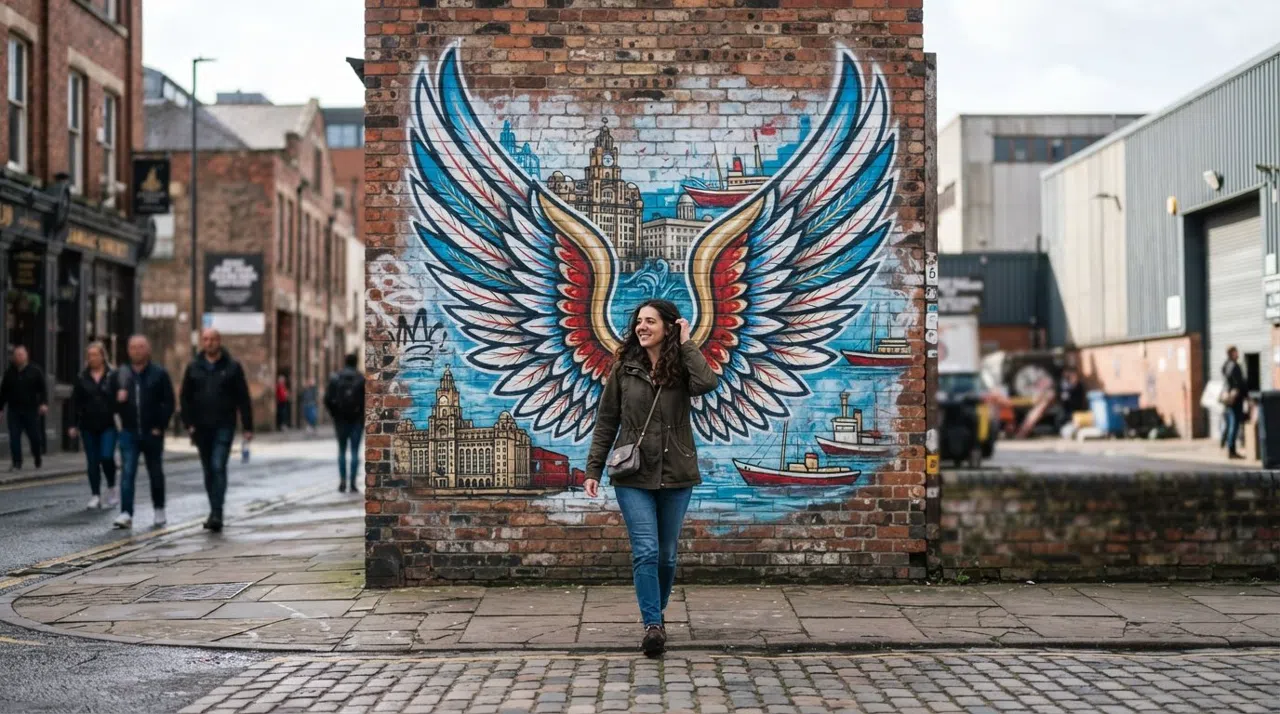

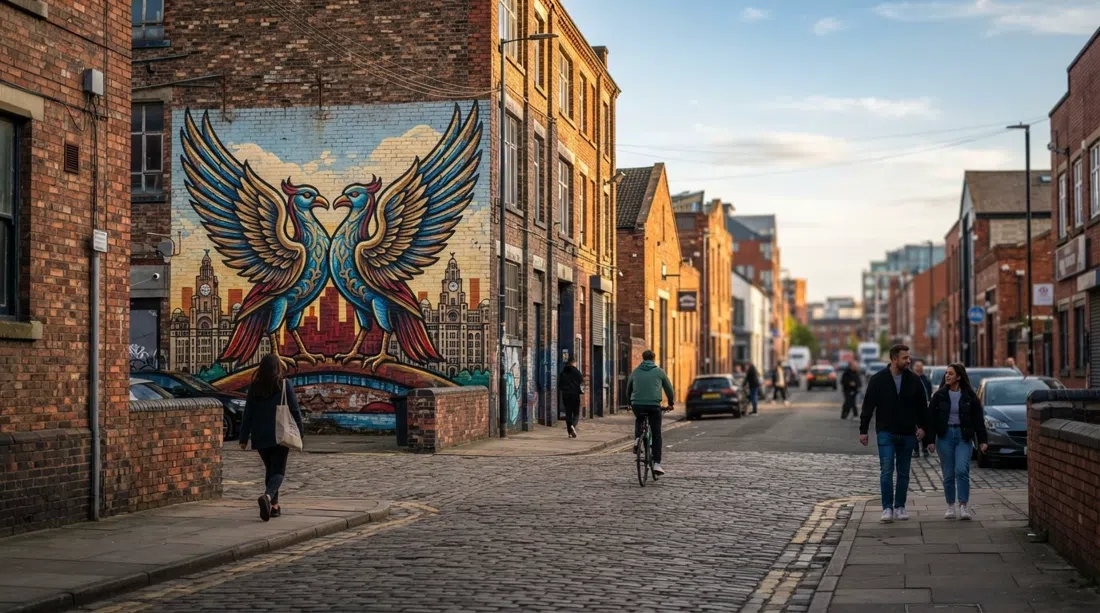
A Saturday in the Baltic Triangle starts with the smell, not the skyline: woodsmoke, hops and whatever’s coming off the grills in Cains Brewery Village, while the queue under Paul Curtis’s painted wings snakes along Jamaica Street for the same photo everybody else wants. That’s the Baltic for you — not polished, not pretending, and all the better for it. This is Liverpool after the last band: bare brick, loading bays, bass bleeding through corrugated shutters, and a quarter that learned how to make a night out of old dockside bones.
What the Baltic Triangle is known for
The Baltic Triangle is Liverpool’s self-consciously independent quarter, the city’s closest thing to a Shoreditch or a Digbeth, except it’s the real deal: a wedge of warehouses and light-industrial leftovers south of the centre, hemmed in by Parliament Street, the dock road and the edge of Chinatown. For decades this was the sort of place people drove through rather than to — sheds that packed rubber, sailcloth and Cains beer, then a long stretch of dereliction while the city moved elsewhere. Over the last dozen years, though, the Baltic has filled back up with recording studios, design agencies, breweries, food traders and event spaces, and the murals arrived to match the mood.
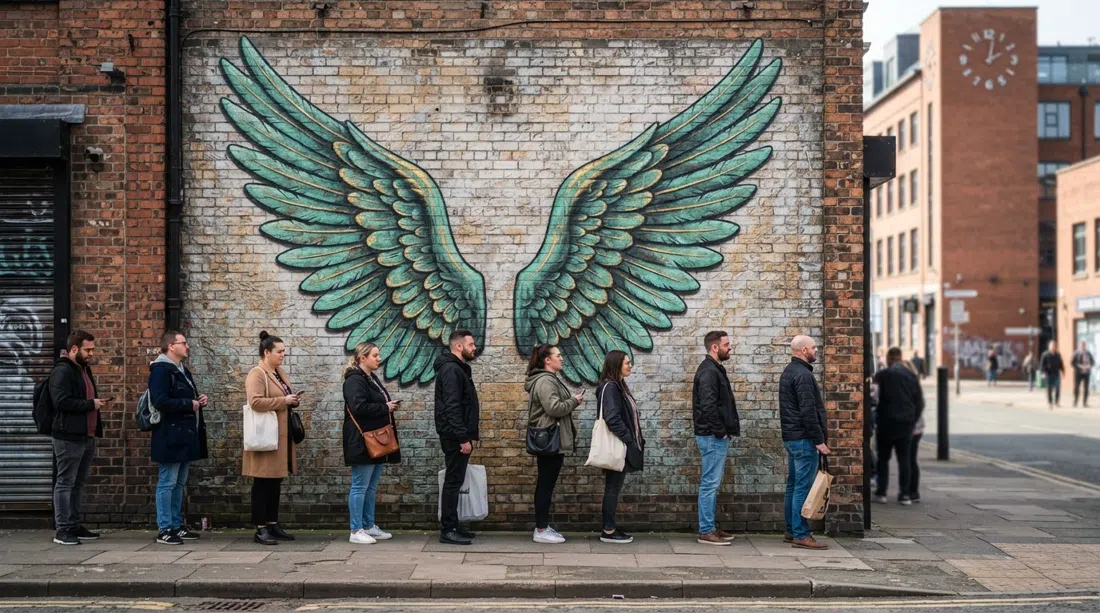
The headline piece is For All Liverpool’s Liver Birds on Jamaica Street, the copper-green wings Paul Curtis painted in a single day in 2017. It turned into one of the most geotagged spots in the UK for a reason: it’s theatrical without being precious, the kind of image that says Liverpool with no subtext and no apology. But the real pleasure is what happens after the photo. Keep walking and the walls keep talking — footballers, musicians, abstract pieces, big blocks of colour that change the mood from one block to the next. The Baltic doesn’t hand you a tidy heritage trail. It gives you a working district that’s still mid-shift, with a dozen things happening at once and a few of them behind a roller door you’d walk straight past if you weren’t paying attention.
The gravitational centre is Cains Brewery Village off Stanhope Street, and it matters that this place is built around an actual brewery site rather than a designer’s idea of industrial chic. Cains has brewed here since the 1850s, and the overhaul has left the bones visible: a sprawling Victorian complex now holding markets, golf, bars and shipping-container food halls under one set of roofs. That’s the Baltic in one sentence, really — old dockland function repurposed into new social life, but without sanding off the rust. It’s why the quarter feels so different from the city centre. You don’t come here for a checklist. You come because the density is good: food, beer, music, murals, then another beer, then a room full of strangers shouting at a bingo caller.
Where to eat & drink
Eating in the Baltic is a story of halls, warehouses and one very good restaurant that remembers to keep its elbows off the table. Start with Baltic Market, Liverpool’s first street-food hall, tucked inside Cains Brewery Village and open Thursday to Sunday. The format is simple and sound: a rotating roster of independent traders, from stone-baked pizza and halloumi fries to fried chicken, dessert and gin bars, with a DJ or live band at the weekend to keep the room moving. It’s the sort of place where lunch can slide into late afternoon without anybody noticing, which is usually the sign it’s doing its job.
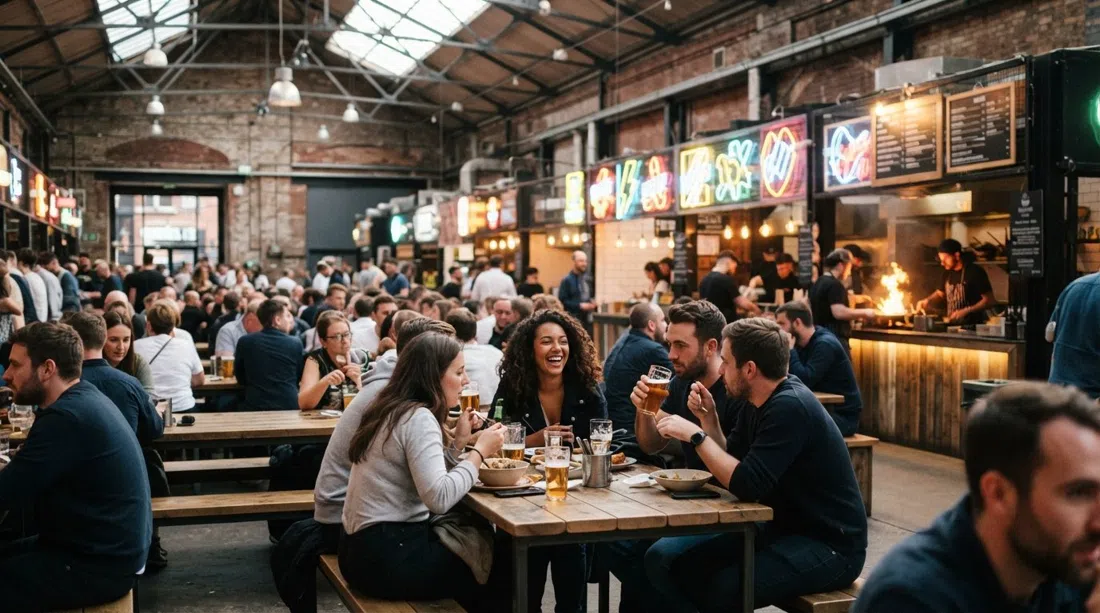
A few doors along, BOXPARK Liverpool arrived in 2024 in the old Canning Hall, the first BOXPARK outside London, and the shipping-container shell gives it a more hard-edged, swaggering feel. Around ten kitchen units and three bars sit inside that black-and-white box, with a big terrace for warm evenings when the whole quarter seems to spill outdoors. It’s built for easy group logistics — everyone can eat what they want, nobody has to argue, and the drinks don’t require a scavenger hunt.
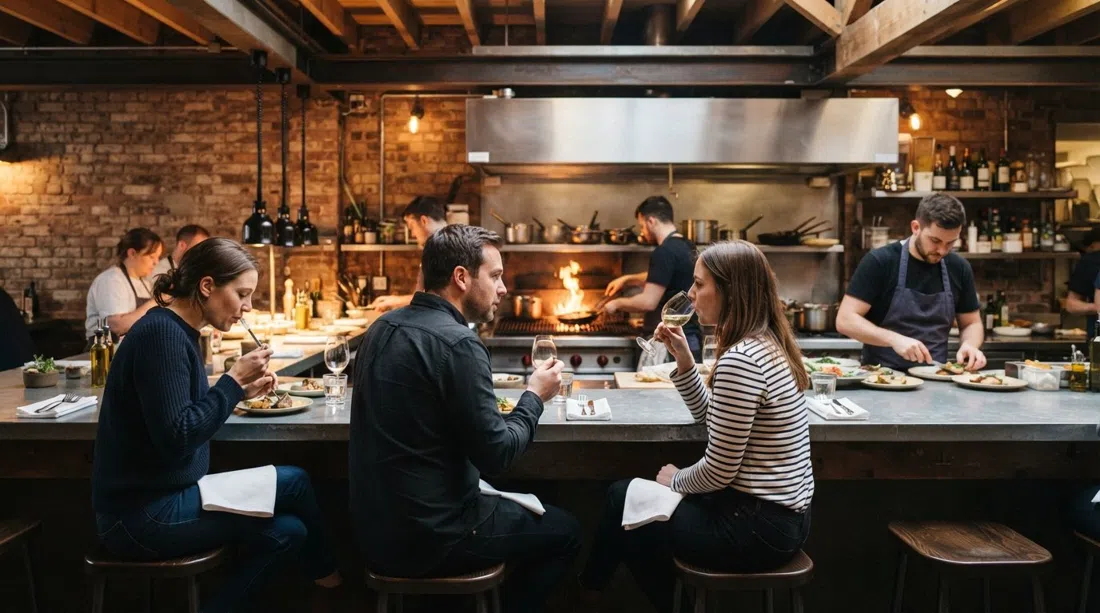
If you want to sit down properly, Manifest at 4a Watkinson Street is the Baltic’s grown-up answer to the area’s louder moods. It’s a modern-British restaurant and wine bar in a converted warehouse, carrying a Michelin Plate, and chef-owner Paul Jones — who came via Moor Hall — cooks with foraging, fermenting and open-fire flavour. There’s an à la carte menu and a tasting menu, plus counter seats facing the kitchen if you like your dinner with a bit of theatre and a view of the knives moving. This is where the Baltic reminds you it can do refinement without losing its rough accent.
For something louder and cheaper, Picante in Cains Brewery Village, opened in 2025, does Mexican street food and margaritas. That’s the Baltic in one of its most honest moods: casual, boisterous, and not trying to be anything other than a good time. And if your day starts with coffee rather than cocktails, the quarter has you sorted. Baltic Bakehouse at 46 Bridgewater Street is the bakery-café people drift to for sourdough, buns, sausage rolls and Bakewells; 92 Degrees on Jamaica Street roasts its own beans inside a co-working space; and Coffee & Fandisha on Brick Street pours Ethiopian-tradition coffee alongside small plates. None of these are filler stops. They’re part of the Baltic’s daily rhythm, which is the point — a place this nightlife-heavy still has to feed the people who live and work here before the queue starts forming.
Going out
This is one of Liverpool’s two big going-out quarters, and the mood is very different from Ropewalks. The Baltic is warehouse nights, craft beer, live music and big-group chaos. The bars are often in former loading bays; the clubs are in old sheds; the crowd is a mix of students, locals, gig-goers, hen and stag parties and people who like their fun with a bit of industrial grit around the edges. If you want glossy, go elsewhere. If you want bass rattling through a building that used to store something more practical than a dancefloor, you’re in the right postcode.
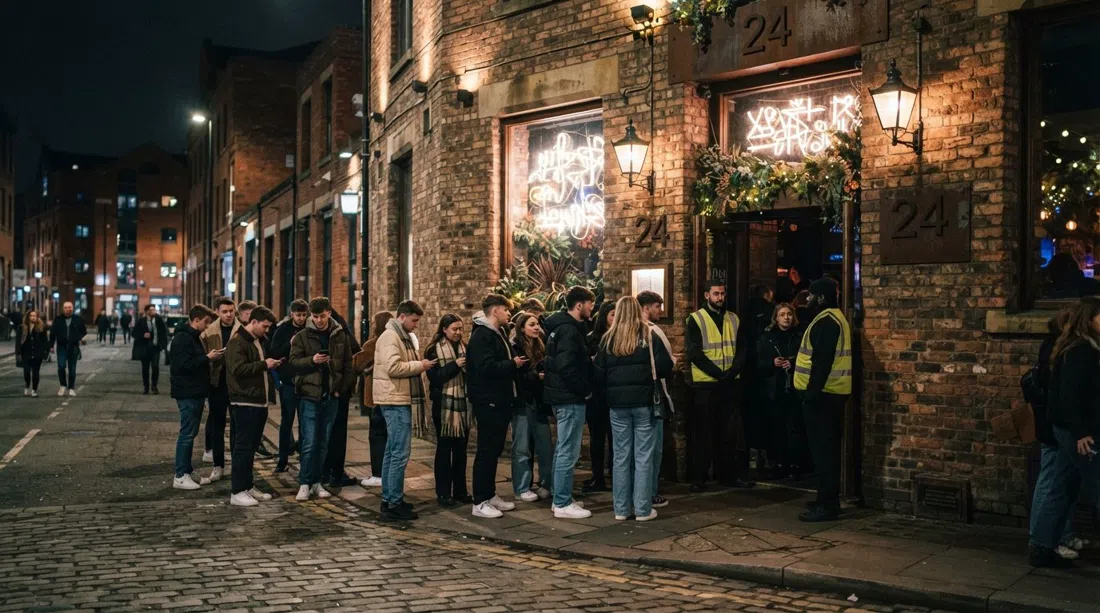
The anchors are 24 Kitchen Street, District and Camp and Furnace. 24 Kitchen Street has been running since 2011 and holds roughly 400 people in a DIY warehouse space that leans hard into house, techno and grime, with the beloved queer party Sonic Yootha among its regulars. District on Jordan Street is more of a multi-purpose gig-and-club venue, with an outdoor YARD space that gives the night a bit of air when Liverpool decides to be kind. And Camp and Furnace on Greenland Street — two vast warehouses doing whatever the city needs them to do that week — hosts touring acts, parties and Bingo Lingo, which tells you everything about the Baltic’s sense of humour.
Then there’s Content on Stanhope Street, the home of Bongo’s Bingo since 2019. If that sentence means something to you, you already know the vibe; if it doesn’t, imagine a room where the rules are loose, the shouty bits are part of the design and nobody is there for subtlety. This is not the Baltic trying to be cool. It already knows it is, in its own scrappy way.
For beer, the district is properly spoilt. Love Lane Brewery on Bridgewater Street brews on site in a former rubber factory and runs a big bar-and-kitchen with its own gins. Black Lodge Brewing on Kings Dock Street is a small-batch taproom that stays open most evenings and hosts the annual Craft Beer Expo each spring. When the weather lifts, the outdoor bars take over the yards: The Botanical Garden on New Bird Street, Liverpool’s original seasonal gin garden, and Sub Rosa on Kings Dock Street, an April-to-September warehouse-yard bar with seating pods and street food. If you want a proper old pub rather than a scene, the Baltic Fleet on Wapping sits on the edge of the quarter with real ales and a cellar microbrewery; if you want something a bit more oddball, Hobo Kiosk on Bridgewater Street pours local beers in a room full of odds and ends. The Baltic is generous like that. It gives you the craft-beer place, the pub pub, the outdoor drink, the warehouse party and the one that feels like it was assembled from spare parts.
Things to do / what to see
The Baltic works best as a walkable open-air gallery with a few big activity venues bolted on. Start with the murals and keep your pace slow enough to notice the walls. The For All Liverpool’s Liver Birds wings on Jamaica Street are the obvious first stop, but the surrounding streets — Jamaica, New Bird and Greenland especially — carry a rolling collection of large-scale works by Paul Curtis and other artists. Some are footballers, some musicians, some abstract pieces, and none of them asks for a ticket. It’s a self-guided trail, which suits the Baltic better than any formal map ever could.
For a proper activity, Golf Fang inside Cains Brewery Village is the crowd-pleaser: neon, adults-oriented crazy golf where you putt through caravans, boats and a toilet while a DJ plays and cocktails circulate. It’s ridiculous, obviously, but that’s half the charm. The Cains complex is where the Baltic leans into group fun, so a rainy afternoon can disappear inside it without much effort. You can wander from one part of the village to another — market, bars, golf, vintage market — and the whole thing feels like a warehouse-sized answer to “what shall we do now?”
The quarter is also where Liverpool’s grassroots creative scene keeps finding room to breathe. Studios, galleries and the odd exhibition space sit in among the bars and food traders, and the area programmes hard around events: craft-beer festivals, food markets, gigs and pop-ups run most weekends. That means the Baltic never quite stays the same for long. Come back and the walls may have changed. The trader you loved might be gone. There’ll be something else in its place, probably with better lighting and a longer queue.
And if you’re building a day around it, the Baltic plays nicely with the waterfront. The Albert Dock and its museums are only a 10–15 minute walk away, which makes the classic Liverpool move easy: a museum morning, then an afternoon among warehouses, murals and beer. That’s a good city day, properly done.
Shopping & markets
Shopping in the Baltic is warehouse-and-vintage rather than high street and chain-store. The main draw is Red Brick Market inside Cains Brewery Village, a big shed of independent stalls selling vintage and retro clothing, antiques, collectibles, vinyl and homeware. It’s the sort of place you wander into for ten minutes and emerge from an hour later with a record, a lamp or a jacket you didn’t know you needed. That’s part of the Baltic’s charm too: it rewards rummaging.
The Cains complex folds in smaller makers and pop-ups as well, so browsing and drinking tend to blur into one another. 92 Degrees on Jamaica Street doubles as a coffee shop and sells its own roasted beans and merchandise, while Ryde at Cains is a coffee-shop-cum-bicycle-workshop where you can buy parts and accessories over a flat white. On top of that, the Baltic runs regular weekend and pop-up markets, so what’s trading shifts week by week. This is not a district for department-store discipline. It’s for one-off finds, independent design and the occasional thing you didn’t know existed until you saw it on a folding table under a warehouse beam.
Where to stay in the Baltic Triangle
The Baltic makes a good base if you’ve come for food, craft beer, gigs and nightlife and you’re happy to walk into the centre. It’s trendy and independent rather than polished, with aparthotels, a few boutique and budget stays and short-let apartments more than a wall of big-brand hotels. That’s useful if you want the buzz on your doorstep, but it comes with the usual trade-off: this is a going-out quarter, so a room directly over a club, event space or the Cains complex can be loud at the weekend. Some streets are quiet and industrial after dark, too, which is part of the appeal for some people and a reason to choose carefully if you’re a light sleeper.
If you want to be in the middle of it, look near Jamaica Street or Cains Brewery Village. If you’d rather sleep, aim towards the Wapping and dock-road side, where you’re also close to the Albert Dock. Either way, you’re not marooned out here; you’re just a 10–15 minute walk from the main sights, with the Baltic doing what it does best below your window.
Getting around
The Baltic Triangle is compact and walkable, which is half the point. Most of the bars, breweries and food halls sit within a five- to ten-minute stroll of each other around Jamaica Street, Bridgewater Street and Cains Brewery Village. Getting in is easiest on foot: it’s roughly a 10–15 minute walk south from the city centre and Liverpool ONE, and about the same from the Albert Dock and waterfront. You don’t need to make a big production of it. You just arrive.
There’s no Merseyrail station in the quarter itself yet. The nearest is Liverpool Central, about a 10–15 minute walk, with Brunswick station on the dock-road side. A long-planned Liverpool Baltic station on the Northern Line has been announced but, as of early 2026, was still held up and not open. Buses run along the fringes on Great George Street, Park Lane and Parliament Street, and a taxi or Uber from the centre is only a few minutes. If you’re coming from Liverpool John Lennon Airport, allow roughly 25–35 minutes by taxi, or pick up the 500 airport bus or a service from the centre nearby. Honestly, once you’re in, your feet do most of the work — and in the Baltic, that’s usually the right way to do it.